
valuing work, play, and learning
thoughts pursuing ellington, mills, and tizol's "Caravan"

Memory’s tuning slips. Error aligns once-familiar objects into false, familiarized patterns that acquire the feel of reality. Why child-me attributed a guitar-shaped object that will feature in this story to the story of the tragi-comically (and gruesomely) killed almost-step-father pilot instead of to the equally doomed trip my parents had taken earlier to Acapulco to ‘rescue’ their marriage . . . well . . . I guess that would be a story. But, since I attempted to play the thing in an elementary school performance, it couldn’t have come from Bellamy. Wherever my parents bought that thing it was not a source of viable musical instruments.
I loved it, though, maybe because of its ill-temperament. I didn’t know that tuning was supposed to be stable, so having microtonal notes that shifted seemed ok. My mother conjured up, or maybe my siblings had left behind? a basic guitar instructional kit containing basic lesson books and records. I still see the basic chord shapes as blue dots with fingering numbers; the record provided an option to listen to the sounds—or “go to your piano” to tune. I also decided that I learned where “electric” guitar sounds came from: closer to the bridge. Oh! What? You don’t immediately evoke a picture and maybe some sense of smell and touch of the strings of this utterly throw-away roadside market Acapulco guitar? Ahh.
8 year-old me believed I could play, and he somehow convinced Mrs. Howington to let me play a song during a 4th grade thing. That event did not start a prodigious career, or even begin a serious pursuit of public performance. Not only was I wrong, but I might have been singularly placed with adults to discourage performance. And, not merely Mrs. Howington, who, judged non-Christian, divorced-mom, liberal me as sub-standard for years. (It was worth it, though, watching her have to work with very lesbian Ms. Williams on the musicals once Mrs. Howington climbed her way from elementary, through middle- to high school, an ascent which exactly corresponded with my years). It also didn’t help that Piano lessons never ‘took,’ despite us owning a truly excellent instrument. Writing this, I think I figured it out. It’s not that my grandmother had been a concert pianist and the prospect was too daunting, ALTHOUGH my mother’s if it weren’t Juilliard it weren’t shit attitude was an impediment. I think it was more fundamental: what I love most about a piano comes from growing up around pianists: being able to crawl under them. We had the Mason&Hamlin tucked in a corner, so it kind of swallowed you up with that sound, but there was just too much mediation between finger, string, and oomph. Even though a guitar is quieter, those strings vibrate around you. Soothing, exhilirating, powerful, connected.
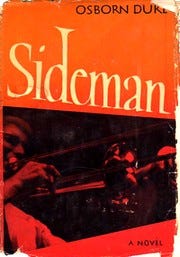
Then middle-school happened, and for the Christmas Break during 8th grade I slipped playing handball, got a massive concussion, and recuperated by reading all of Lord of the Rings and binge-listening to Fleetwood Mac’s Rumors. Especially “The Chain.” I really wanted to play bass. I tried to play that break on that little guitar. My mother said no bass, guitar, and that I could start learning with Olivia. Olivia was the about-to-graduate daughter of my mother’s friend Myra. Myra was an award-winning soprano and had been a featured vocalist on Your Hit Parade. Olivia’s dad had written a well-reviewed novel about jazz musicians called Sideman in the 50s; he was my dad’s best friend. Like my dad, he wasn’t really around anymore, but Myra taught elementary school music up on the disadvantaged North Side of Fort Worth. Unlike Joy Howington, she had no interest in ‘advancing.’ She had to fight to keep her position, actually, because the Howingtonesque powers decided there was no way Myra could teach singing and basic music without playing the piano proficiently. A little pressure campaign, part of which involved reminding them that she was the GB Dealey vocal award winner the year Van Cliburn won for piano, worked. During her final illness, a couple of generations of students sent her condolence and reminiscence cards.
I knew her for ever, and except for singing, I never ever heard her voice. And even then, soaring above piano and a rhythm section and maybe a horn or two, you’d never think she was loud: just effortlessly perfectly present.
But unlike my mother, she seemed willing to let Olivia pursue a career in music. Although, she was way more agreeable about letting Olivia go to San Francisco to find opportunities in the Lesbian scene. Olivia was a 17 year-old musicologist and jaw-droppingly good guitarist. Right around the time Van Halen was about to emerge, she played Reverend Gary Davis, ragtime, pieces, and Janis-inspired blues. She knew Sister Loretta and Fanny. My lessons with her didn’t last long, but they lasted—not only did she give me BB King and Bobby Blue Bland "Together” and Michael Jackson’s Off the Wall, she also insulated me from thinking that macho guitar heroism was anything to pursue.
She also gave me the first guitar that I could actually play.
Our first lesson began with her parking me in front of their upright piano to tune the Acapulco pretend guitar. Tuning was always a compromise, and in my desperation about this being a real lesson, I decided that all of the pegs had to line up for it to tune. Didn’t everyone take 10 minutes or so to tune? Olivia’s face when she came in to check on me registered a clear ‘No.’ After a couple of minutes, she changed my life. Reassuring our mothers that I wasn’t a tuneless idiot, she announced, “this thing won’t tune. He can’t play it.” Before disappointment had a chance to spread to the certainty that my attempt to play guitar had ended, Olivia put that thing away somewhere and returned with a steel-string acoustic, apologizing that the strings were old and that it didn’t have a case.
I mean. It was loud, it tuned, and we spent the rest of the time with her showing me “One Way or Another” and “My Sharona.” Although it got sidelined by the electric that showed up for Christmas (and I wish I still had), I kept that acoustic for a few years. It went back to Myra, who donated it to her elementary school’s music room. Olivia moved to San Francisco, and Myra and my mother mostly left me to my own devices musically.
Reflecting, it only now strikes me as odd that neither one of these veterans of professional music put forth any effort beyond getting me an excellent (if cheap) guitar and excellent teacher. Those are significant, of course. At the time, I think I understood it as a function of how thoroughly my step-siblings had come to hate music as a result of Youth Orchestra, Boys Choir, and High School Bands. They toured the US and Europe, gone for Summers at a time, essentially. At about the same time, I fell asleep amidst grown-up coats and Cecil B. Demille movies during parties at the McLean Band Director’s house. There’s no way of telling why no one ever suggested that I play in school: lack of displayed talent? Burned bridges? Maybe the small detail that they didn’t include guitar in the music programs?
With the exception of some church performances (which were safely out of sight up in a choir loft), the only time I ventured into what could have been that world occurred Junior year of high school when we produced Bye Bye Birdie. I convinced Mrs. Howington (yes, indeed), to let me work with the guitar book for the score. My idea was to sit in the pit and play the charts. I worked with my private teacher on reading the guitar charts in the ‘book’. When I wasn’t perfect day 1, Mrs. Howington pulled the plug and left me with one 3-chord song, “Are You Gonna Be Sincere,” which I did on-stage. I was mortified. But I was never presented with the option of joining the rest of the band students who practiced their parts in band class.
I might have lacked, might still lack talent, but I loved playing. Scales, chord forms, rhythms, learning songs, just about everything except trying to learn “solos.” After John showed me how simple, relatively speaking, “Free Bird” was, especially compared to anything bebop, learning my own improvisations became the path. He had me listen to Olivia’s records for the rhythm parts: how BB King’s rhythm guitarist set him up, how the guitar parts on Off the Wall made the songs groove. Even if I never played out, and didn’t join bands, I played. Most of the time, in fact. No social media, no internet, no playing so “I could meet girls” or whatever the logic was for social validation. But had anyone stopped by when I was home, odds are, I was playing.
And now? I remain perplexed by the systems of value developed to commodify musical performance. Although I fantasize about waking up some morning to having “gone viral” for some clip I shared, I know it won’t happen. The learning and playing is selfishly about what it feels like to learn, play, and approximate mastery. It’s been a life-long gift, really, playing and learning without the concern of making it pay, or cultivating the interest of others.
The gift reveals itself in showing me things I do—things that must be a part of me, since they appear without planning, or practice, as well as parts that emerge out of dreaming and pondering as if they were unplanned. The intimacy of the interaction between fingers and strings; the persistence of the thoughts about possible voicings—these conditions enable emergences and behaviors that feel like learning, and occasionally sound like music. It all resonates personality. Even with frets, how one places fingers, how hard the pressure, the infinitesimal variations in vibrato, choices or habits of where you initiate vibration on the string: all of it communicates distinct signals.
From somewhere a fundamental tension and resistance and tightness clenches my mouth and tightens everything when I practice. Is this a projected judgments and resistance to the decisions of others? Part of it is practical: there’s a lot to orchestrate. Before music can happen it has to overcome this straining as the interplay between thoughts, mouth, and fingers works its way down to where feet and legs and arrange time and breath.
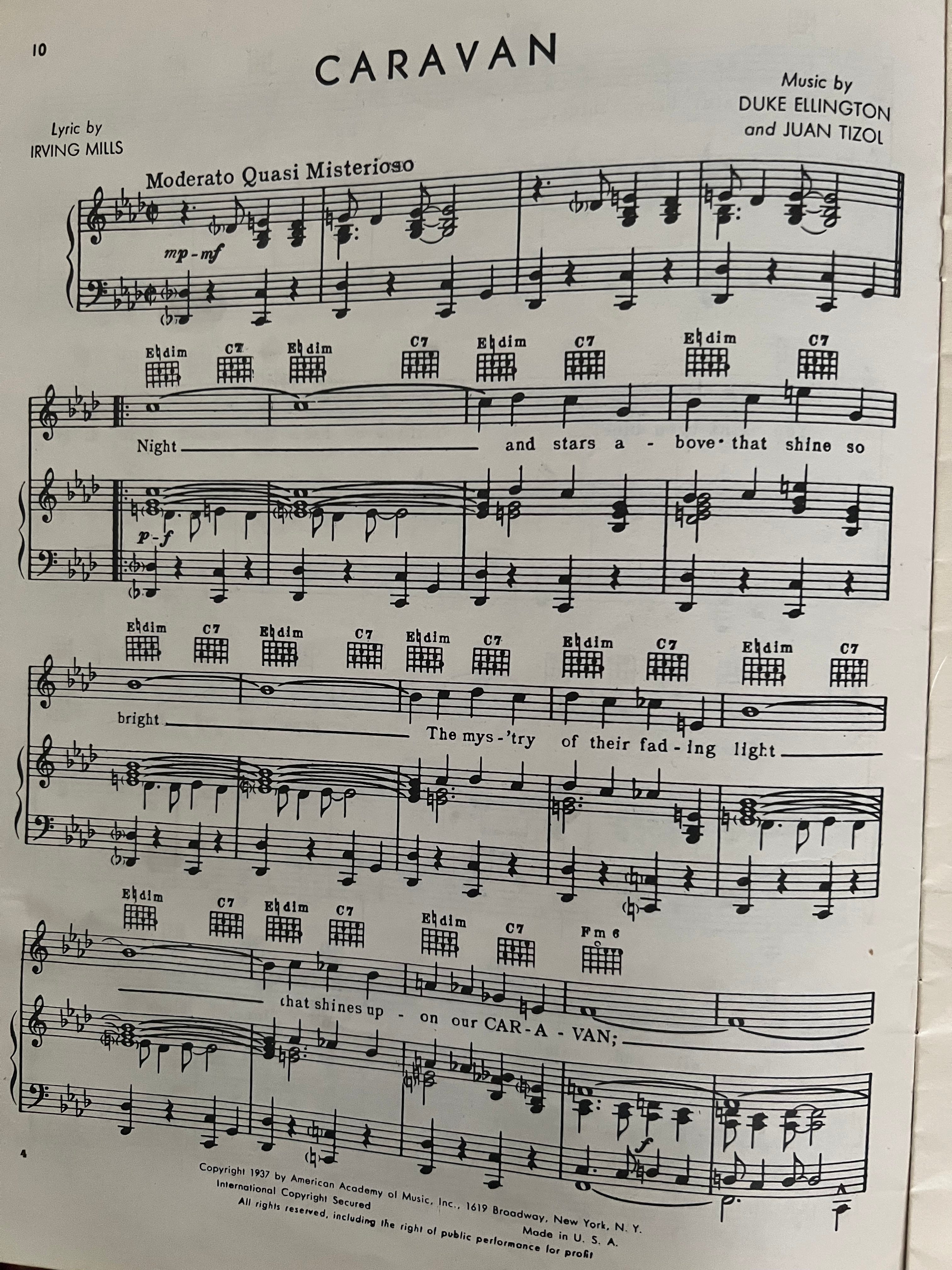
Inspecting the first 2 bars of the chorus, there are 4 parts to account for, with 6 strings. There’s the melody: that top c. Not difficult to finger, but hard to sustain for 2 bars with everything else going on. The E diminished under it is also manageable. That d-flat to e line, though. That’s a finger-breaker, ESPECIALLY if you try to play the d-flat to c octaves in the bass. It’s just possible as written. But . . . then there’s the temptation to sneak the C7 listed by the guitar chord—which requires dropping that octave. (And as an aside, this is the only version of “Caravan” I’ve seen where that first chord is listed as E-diminished. All of the others list it as D-flat diminished because they take it from the bass instead of the harmony). And all of those features need to inter-act, especially the the e sustaining while the c goes to g in the second measure: that’s what makes the riff. But . . . that melody has to hit right on the 2 of bar 3 each time. Sneaky.
I hesitate to play loud. I rarely plug in. Often I return to those first lesson feelings of panic and desperation almost any time in public, like say at a guitar shop playing an unfamiliar instrument where anyone can see me, because I’m channeling and pre-empting. Then, sometimes the magic happens. When the pieces fit together and I can recognize the song—from arranging the sheet music, pondering the rhythms, choosing voicings without listening to a recorded version. It’s really fun. And if I leave it alone for a couple of days, work through it gently, usually, the clenching stops and it can almost become music.