
short-circuiting war consciousness:
reimagining 2 lines from scene 16 of gravity's rainbow

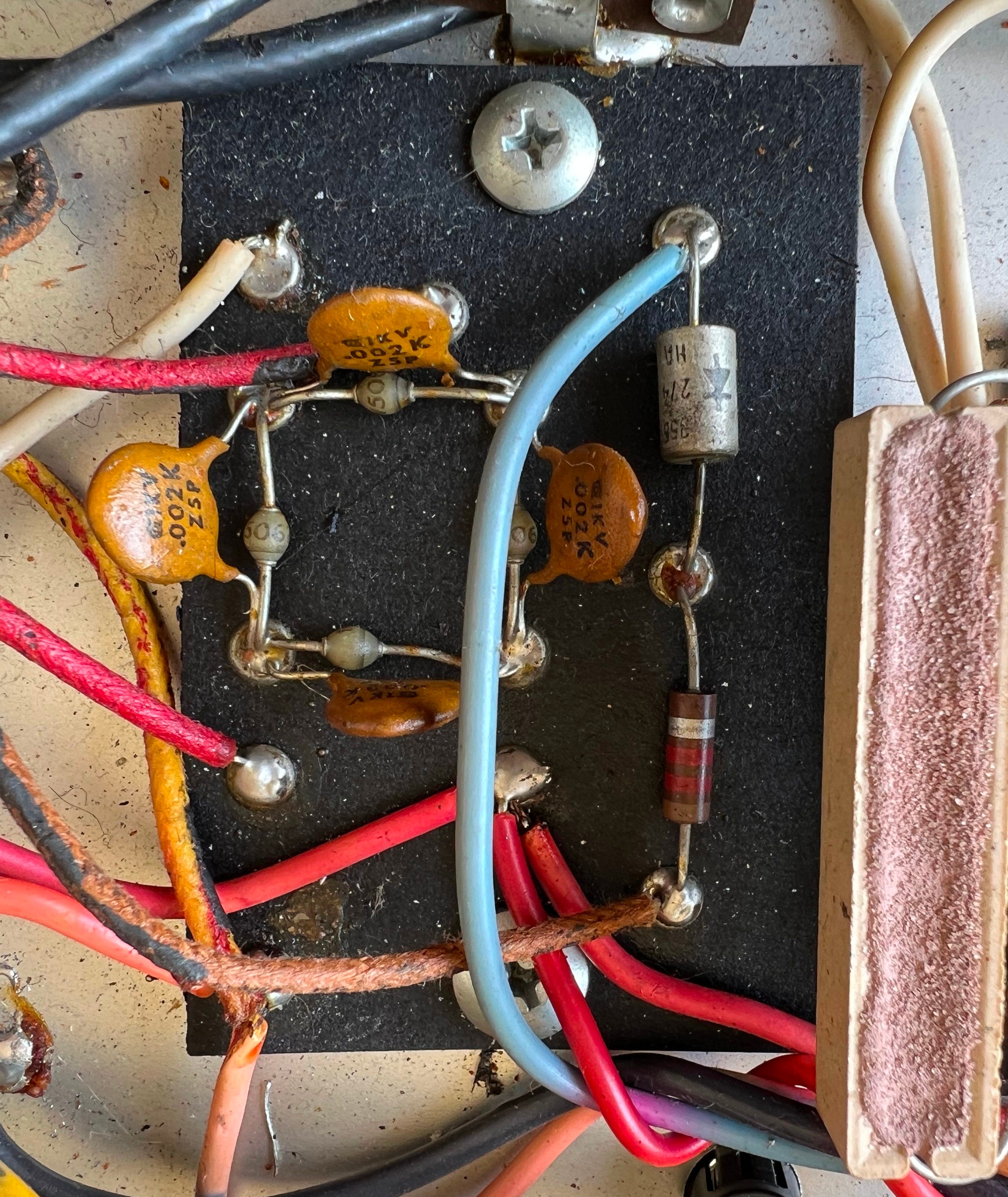
The posts in which I advocate for thinking of literature as constructed circuitry for channeling emotional voltage have not drawn readers. I have made neither a milkshake nor a charged plate. But why would they? Electronic concepts, the terminology, the schematics, funky pictures and diagrams all seem unnecessarily arcane and distant from human applications. And yet, we do assemble identities and meanings from assembled circuitry that makes components and structures to deal with flows of emotional currents and voltages that are electric. (And, isn’t this easier to read than Deleuze and Guattari? (maybe don’t answer). Freud knew this and then veered off in a different direction. We (a very loosely defined pronoun) are returning to it because it does not have to confine us to a deterministic set of positions about “affect” and “hard-wired” cognition. It looks to me, and I agree with Pynchon, that Pynchon insinuates that this insulation and alienation from electrical thinking about the self is a deliberate intervention.
If you know you know, runneth the acronym. The converse is more consequential: if you don’t know, you can’t know. If you think you know, but don’t, you will always be firmly, completely committed to upholding and defending bs. This is true individually and culturally. Take, for a quick example, the mythos of the brave paleolithic hunter (and their diets) around which so much patriarchal essentialism revolves. Damn LIDAR. Across continents industrial level kill-zones and slaughter-runs have emerged that pretty much confirm that ancient ‘hunters’ were about as brave (or maybe even less so) than Bocephus and Bubba in the deer-blind. Yeah, complications. But the point holds: how we understand should change as we confront evidence that our modeling of ‘reality’ was built by people with an agenda to create slaughterhouses for animals and us.
Another example, slightly more relevant to Pynchon’s interest in “the War”’s obsession with conditioning and structuring behavior and consciousness: it might well be the case that the whole Lockean metaphor of tabula rasa is full of shit because Locke used a textualist, scriptural metaphor to understand memory and understanding. A study in Austria suggests that a networked, circuit-focused understanding would be more accurate and shows that learning and development proceed by ‘pruning.’
Thus endeth most of the polemic part.
How to change? Incorporate different figures and patterns into how we imagine: and then . . . imagine . . . a different product. As an example, here’s my recalibration of a sentence I misread and a sentence I ignored because I didn’t know how to process them. They appear in the middle of scene 16 (Advent 1944, mostly) of Pynchon’s Gravity’s Rainbow. The scene in which they appear pits the “paper specialties, paper routines,” how “The War needs to divide this way . . .though its propaganda will always stress unity, alliance, pulling together” (GR 130) against the 1944 Advent when “Roger and Jessica came upon a church” and briefly experienced the charge of a different potential (GR 127).
The sentences lurk in a bravura 5-page paragraph. Pynchon contrasts “Advent from the sea . . . blows daily upon us, all the sky above pregnant with saints and slender heralds’ trumpets” (GR 131) to “The War needs electricity” (GR 133). Prospective blitz and rocket survivors “want the nearly postwar luxury of buying an electric train set for the kid, trying that way each to light his own set of sleek little faces here” (GR 132). The “Electric Monopoly, aong the power companies,” conversely, struggles “to keep Grid Time synchronized with Greenwich Mean Time” and align demand, chronology, and the flow of historicity (GR 133).
That sentence about lighting faces concludes with a frustration that for years I only could see in terms of overt setting and subject: men in train stations wanting to buy toy trains for children: “brought to life now, oohs and aahs but not yet, not here in the station, any of the moves most necessary: the War has shunted them, earthed them, those heedless destroying signalings of love” (GR 133, emphasis added). Sure, rail cars get shunted, and “earthed” is an English term for electrical grounding, so the electrical meaning isn’t obvious, but the sentence fuses vehicles to form a compound metaphor: electric circuit, electric train, ‘real’ train, cultural circuitry designed to shape children’s joy in the image of the War. One reason, I’ve come to learn, why I dislike 80s and subsequent “high-gain” guitar tone, is that to make that crunchy sound you have to shunt 60-80% of the bass frequencies in the signal to ground: it’s a really filtered and impartial signal that gets through to amplification. It ain’t, in other words, all about that bass—and, that’s what Pynchon’s getting at: War consciousness shunts most of the signals that could drive a real advent out of a circuit that could produce emotional connections.
Still, this moment generated a charge that exceeds commodification to gifts which children will receive in the context of “last year’s . . . reincarnated Spam tins” forced into duty as Christmas gifts (GR 133). It would be a leap worthy of Marx’s imagined leaping commodity-forms to connect those Spam tins to Marx’s spirit animating commodities—the ‘spirit’ which animates Capital. It certainly looks as though Pynchon makes that spirit be the spirit of play. Imagine, think, if you must, how all of the economic and cultural theory turns this fundamental recognition into so much unfun work: we’ve obfuscated the basic truth of how oppression works—they form our desires, needs, structure our experience of reality by regulating the voltages of play and love in stories of “supply and demand” and other pseudo-scientific fictions.
The other line metaphorizes why it is so difficult for most of us who have not felt a living current flow through us to recognize and accept truths that “lies/ Too bright for our infirm Delight” (Dickinson F1263). The line (which only obliquely invokes Dickinson) seems a throwaway. Pynchon asks us whether we think Advent is “a children’s story? There aren’t any. The children are away dreaming, but the Empire has no place for dreams and it’s Adults Only in here tonight” (GR 135). [This might have something to do with why it’s a struggle to get Bruce Cockburn’s “Cry of a Tiny Babe” on holiday playlists, with its reminder that Joseph, Mary, and child had to escape Herod’s death-squads.]
What’s the line? It seems merely descriptive of landscape in Pynchon’s granular, molecular, hyper-real manner:
“the tall red busses sway, all the headlamps by regulation newly unmasked now parry, cross, traverse and blind, torn great fistfuls of wetness blow by, desolate as the beaches beneath the nacre fog, whose barbed wire that never knew the inward sting of current, that only lay passive oxidizing in the night . . . “ (GR 134).
It continues to this dominant clause: “because of the War” (GR 134). Prohibitions, Proscriptions, Exclusions, Denials, Perversions—because of the War. Emotional voltages and Imagined realities generated and transformed into the potential that made this world through, Pynchon details, racialized rectification and filtering and a consignment of many of us to rust rather than current and communication. All this to support the generation of currency: “the real business of the War [:} buying and selling” (GR 105).
“You will want cause and effect,” Pynchon writes much later (GR 663), by way of introducing a character longing to be struck by lightning. “Well, it’s a matter of continuity. But people’s lives have ups and downs that are relatively gradual, sinuous wave with first derivatives at every point. They’re the ones who never get struck by lightning. No real idea of cataclysm at all. But the ones who do get hit experience a singular point, a discontinuity in the curve of life—do you know what the rate of change is at a cusp? Infinity, that’s what! A-and right across the point, it’s minus infinity! How’s that for a sudden change, eh?” (GR 614).
Continuity carries a triple-valence: plots, mathematical and narrative, and electrical flow. Plotting lives as sinuous waves, though, emphasizes their electrical nature—since this is what one does to observe and test the behavior of amplified signal waves. Of course, someone struck by lightning would also experience the inward sting of voltage and the rush of current shuntin to earth.
A tragic element in Gravity’s Rainbow involves the construction of cause-and-effect to legitimate frames of reality that perpetuate War. Attempts to make circuits of experience discontinuous with, separate from it fail—or disappear from the fields of transformation we use to render ‘reality.’ We might crave a narrative circuitry capable of emplotting a reality discontinous with “war,” I’ll conclude with an unusual—and textually supported—continuity: Emily Dickinson’s lightning poems and the circuitous truths of what it’s like to live transformed.
One of these poems, written in 1865, when “it all began to go sour for "[the Slothrops]” (GR 28), announces “Crash’s law”
Ruin is formal. devil's work
Consecutive and slow -
Fall in an instant no man did
Slipping is crash's law (F1010, qtd in GR 28)
Dickinson’s 100s of lighting (and volcano) poems and circuitry poems and transformed identity poems don’t appear as directly in Gravity’s Rainbow, yet Pynchon writes that she “is never far away” (GR 28). What might that apparently irrelevant line mean? Scholarly habit would list poems, catalog references, tropes. But the point connects the soldered experiences, the lightning blasts, the slants-of-light: the “heavenly hurt” (F320), the “seared saplings” and “scalped trees” (F451) that discontinuously reveal a world “beyond” “This World”: “Invisible as Music/ But positive as Sound” (F370).
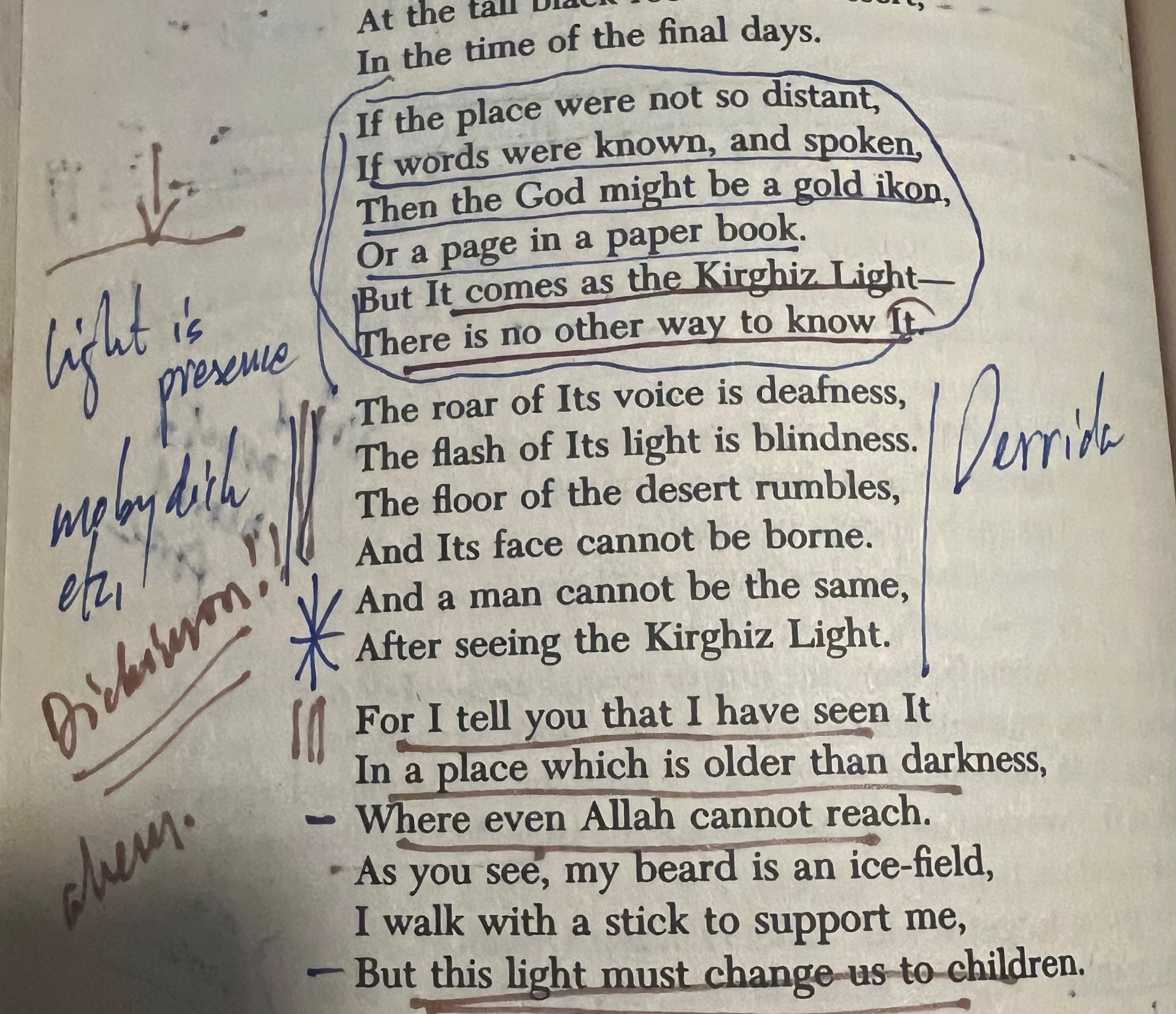
Reading Dickinson requires the same kind of fused metaphors and polysemy that appears in those Advent lines: “Success in Circuit lies” (F1263). Recognizing that her presence is, indeed, never far away in Gravity’s Rainbow, well, that’s been embarrassing. My annotations, though, out late 1980s me. Here’s something from the Aqyn’s song (GR 357-359).
Compare, almost at random, and using a poem for sure in Johnson’s edition: “Before I got my eye put out” (F 336). If there is a point—a trajectory, a target—for Gravity’s Rainbow, it might be a cautionary tale about how points and trajectories, discourses, and plots cause an eschatological madness of filtering and attenuation. The equations do not accurately model or predict, because anyone of the variables and constants in that equation could be, and probably are, wrong: this is why the rockets land in a poisson distribution. Slothrop fantasized the sexual encounters that drive Pointsman to try to exploit him—they too falsify the already ridiculous Pavlovian dogmas Pointsman thought conditioned Slothrop (who nonetheless had been abused and trafficked as an infant): These equations overlook the “mercy of small things” (GR 362), whether that any of the conditions that compromised the rocket’s status as something “that can move, or that has a Destiny with a shape” (GR 362).
One of the big things, though, Pynchon insinuates, is an emotional feedback and support system, that he seems to believe, is lacking in writing: before the Aqyn sings his vision, he “appears to be sleeping” (GR 357), but is not. Instead, he mediates and directs a “singing-duel” that appears headed towards physical violence towards “comic cooperation” (GR 357): “he radiates for the singers a sort of guidance. It is kindness. It can be felt as unmistakably as the heat from the embers” (GR 357).
I just wrote in running down the voodoo about critics usurping the place of audiences to assume the power of judgment. It’s a move they copped from literary critics, who spent the first part of the twentieth-century deriding the sentimentality and banality of so-called “fireside” literature. Real literature couldn’t be read aloud, they stentored. Real literature did whatever real literature did: reinforce the ‘greatest that’s ever been thought, etc.’ And, as Graham Greene knew full well, and based much of the plot of The Quiet American around, the “humanities” professors of that time were eager co-conspirators in the colonial project in which the petro-chemical “cartel [became] the model for the very structure of nations” (GR 349) with disastrous results.
And, yet, there has to be a different way of reading (and writing) stories that develops our powers of connection: that “inward sting” can also be the warmth of connection—the feeling of current flowing—whether we feel it as heat radiance, blood-flow of pulse, or emotions. A [final (couldn’t be final, that’s just words)] sneaking Dickinson presence in Gravity’s Rainbow, then, could be Pynchon’s Dickinsonesque personifications of just about everything, radiating out from those submerged fence wires, to Vanya the dog, Snake the horse, and who knows what and who else.
I hate conclusions. It seems preposterous, especially when confronted with the written records of just how little I knew (and how desperately I wanted to be taken seriously as someone who knew a lot and could arrive at profound conclusions). So, I guess, if you find yourself wondering why everything around you seems designed to filter out and attenuate feeling, why it’s all about screening you away from . . . heck Elvis Costello sang it decades ago in “Radio, Radio” “anaesthetize the way you feel” it’s because subjectification is about the process of rendering you funkable for mind-control (as George Clinton put it): Hegel and those guys can scrawl what they want, but the machine don’t want tunas with taste, it wants components it can plug into its circuits. Which requires diminishing a whole lotta love.