
things we omit
fragments of a history of epsteinism

I reported a hopelessly misogynistic post on a guitar forum. Not the all-too-common “don’t tell my wife about the guitar or gear I bought” (a variant of the same version of bro-culture also appears in cycling, golf, or whatever activity dudes use to maintain a sense of themselves as hyped, sporting-bros who need to prove that they could “live without a woman’s charm” (“She’s No Lady”)). This one responded to a technical question about how to wire a 4-way pickup selector switch with a photo of some dude surrounded by 5 teen-looking girls and the comment, “I’ve had a 4-way.” Why does someone think that’s ok, or funny, to post to a forum dedicated to the technical features of an electric guitar? Alas, we know why, but we don’t hate it, shame it, or expose its powerful hold on patriarchal belief systems enough. This next-door version of Epsteinism shows its debilitating and wide-ranging effects on human identity, culture, and possibility.
It also has a long, and widely ignored, history. That cultural expectation that it’s ok to exploit girls (& boys) unites the Kennedy family, Rolling Stone journalistic attitudes, Harvey Weinstein, Woody Allen, Jimmy Page, Ted Nugent, Ike Turner, Bill Clinton, Lindsey Graham, Kenneth Starr, Steven Tyler, Donald Trump, Noam Chomsky, Bill Gates, and Epstein. Maureen Callahan’s Ask Not: The Kennedys and the Women They Destroyed documents how one powerful family—and women caught in it—normalized this phenomenon.
Placed within #metoo, Callahan still stays inside the lines in her “reporting on the Kennedy dynasty’s patrimony” (343). Reading beyond Callahan’s text, or along with it, I began to think that Marx was wrong: the ultimate system of value is not labor, it’s exploiting girls (or boys). Think Zeus beating off (pun intended) Cronus—and then turning to an eternal career of grooming and raping children. But, also, think about how much you haven’t heard about the nineteenth-century “sporting-male subculture” in which unregulated sex was the categorical imperative” (Gilfoyle 99). According to Timothy J. Gilfoyle in City of Eros, it was not limited to the dregs covered by David S. Reynolds’s Beneath the American Renaisance: it involved “men from all levels of society . . . in open displays of sexual indulgence and aggressiveness” (Adler rev. of Gilfoyle). Sex-work, as we’ll see in a few paragraphs, “occupied a prominent and remarkably public place in New York City life” throughout the nineteenth century. And Boston as well.
Systemic precursors to Epsteinism exist. The practices and attitudes that celebrated and hid misogynist trafficking and exploitation in plain sight as “living large”—the P Diddy Hamptons lifestyle that every man who’s a “man” wants, and will privately brag about but not publicize.
15thCenturyFeminist’s work (among others) can be read to show that despite the millennia this disease has existed, the post-Samuel Richardson, Fanny Burney, and Jane Austen “marriage market” that erased the contributions of elite women beyond child-bearing and “accomplishments” has skewed how we understand the family, human sexuality, and basic morality. Long ago, Margaret Ezell showed me how Aphra Behn’s works, Moll Flanders, and the exhaustively documented Sex Among the Rabble challenge this manufactured consensus. Firmly planted in a 20th-century manufactured reality, Callahan “tells the stories of women whose lives were upended by Kennedy men” (xi), but does not explain or examine the larger systems that brought smart, educated girls and young women to believe they “needed to keep” a man who never bothered to learn their names by giving another man a blow-job (294). We could dive into the gothic potential hinted at in Ann Radcliffe and the novels that continue to probe Clarissa’s grooming—or imagine Wickham and Lydia.
Retail Victorian culture competed strenuously to deal with an almost complete transformation of traditional cultural practices. Everything changed: especially how culture socialized adolescents of both sexes in burgeoning cities and factory towns. There’s nearly a century before a truly national High School and teen culture develops in the 1880s through the 1920s and the breakdown of the apprenticeship system in the cities in the 1810s and 1820s. [A semi-tangential example: the oldest High School Marching Band in Texas formed in Abilene in 1923]. Matthew Arnold’s Culture and Anarchy appears in 1867. Much, most of the nineteenth century was wild beyond the rigid confines of the 1% of society reflected in Byron, Tom Moore. Great Expectations much? Hard Times and Oliver Twist demonstrate the reality Dickens mined to profit from them: at least Blackboard Jungle occurs in a somewhat functioning school system. Perhaps Adolescence veers back to the real Victorian era of laissez-faire Gradgrindian misogyny.
How did Victorianism produce Wexner’s and Epstein’s Victoria’s Secret? (Come on, that one’s too obvious). Before Ghislaine and Jeffrey, definitely not working in a pizza parlor, there were procurers and agents—some of whom got spiffied up to appear in Damon Runyon books and movies, while others waited to appear on the margins, but never centered, to be insulted by main characters in Scorsese and Coppola movies. One fragmentary, non-fictional path of entry into this world exists alongside the question of why Patricia Cline Cohen chose not to consider Nathaniel Hawthorne’s life-long best friend, Horatio Bridge, as a possible seducer of Dorcas Dorrance as she began her trajectory towards becoming Helen Jewett, the most famous murdered sex-worker in nineteenth-century America.
As Hawthorne hung serious clues in The Scarlet Letter in the tapestries placed in Arthur Dimmesdale’s room, I’ll hang this speculation around two pieces of art that might have inflected Dorcas/Helen’s trajectory. One in Augusta, Maine, one in Manhattan.
Access to sex-workers and opportunities for sexual adventure were presumed as fair-game for male members of the Patronage class: Hawthorne mentions it of Judge Pyncheon in House of the Seven Gables, after all. Until Victorian politeness began achieving literary (and then behavioral) triumphs in upper-class norms, what Timothy J. Gilfoyle calls “a sporting-male subculture” ruled beyond the parlors of the 1% (99). “Unregulated sex . . . and open displays of sexual indulgence and aggressiveness,” notes Jeffrey Adler, in his review of Gilfoyle, “was the categorical imperative” presumed by “men from all levels of society.” Sex-work “occupied a prominent and remarkably public place in New York city life” throughout the nineteenth century.
While some community members freaked out about the total collapse of traditional apprenticeship models in early 19th-century New York, Patricia Cline Cohen focuses Gilfoyle’s work to show that John Livingston—the financier brother of Constitutional founder Robert, who helped Hamilton “guarantee . . . full repayment of the public securities” (Cohen 118)—profited from this breakdown. Livingston was, “for thirty years . . . the single largest owner of brothels in [New York]” (Cohen 118). Robert Richardson murdered Helen Jewett in one of them.
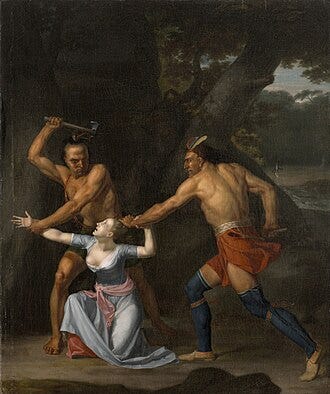
It’s likely that one of the last things Richardson saw before making his way to Jewett’s select room was Vanderlyn’s painting The Death of Jane McRae. While Cohen can’t conclusively place it on the wall in the lounge of the 41 Turner Street mansion, she makes a plausible case that “a person blind to the terror on Jane McRae’s face could have thought that the depiction of so much naked flesh was just the thing to dress up a brothel wall” (122). And John Livingston had access to it, its whereabouts during the period are unaccounted for, and multiple witnesses described seeing it on the wall at the time. Indeed, Cohen details similarities between some of the fantasies Jewett included for her correspondents in her letters with the “voyeuristic fantasies cloaked in noble motives” one might see if one identified with the all-but hidden rescuer (Cohen 124). There’s also the obvious playing savage trope—so well documented in Annette Kolodny’s Lay of the Land, of “exercising total sexual power through threat of violence” (Cohen 124). It’s peculiar that Cohen hedges this behind a “male viewers of the picture might contemplate . . . darker subterranean themes in the psyche” (124). Darker subterranean themes exist in Charles Brockden Brown’s Edgar Huntly, Vanderlyn’s painting flaunts them.
Over 30 years separate Cohen’s 1998 true-crime extension of Gilfoyle’s City of Eros and Marilyn Wood Hill’s Their Sisters’ Keepers: Prostitution in New York City, 1830-1850 from Jane Smiley’s A Dangerous Business (2022). Smiley’s novel—set in early 1850s Monterey—sets Hill’s account of the opportunities afforded women by sex-work against the threats posed by Robinson. Setting her story in California, though, allows Smiley to bypass the business, social, and political developments Gilfoyle covers. Her Eliza Ripple can go directly from her husband’s death to a protected status in Mrs. Parks’s business without the obvious, if ignored intermediaries who would have been required to get Dorcas Dorrance from Augusta to Portland to Boston to New York (and through a couple of noms de amor before landing on Helen Jewett).
Jewett’s 1830s Manhattan was at least as tolerant of “nonmarital sexual activity” as Smiley represents 1851 California (Cohen 85). Brothels sometimes stood next-door to police stations and officers. Fire-stations, City Hall, Art Museums, and their owners mansions existed within walking distance. Jewett’s working locations differed from the 5 Points locations studied by Rebecca Yamin (2005) and Allie Marchesani (2022). Jewett worked in, and, in her frequent stints as a mistress, from, what William Sanger classified as “First Class” brothels, which were advertised in widely distributed guides (Hijar; Marchesani 31).
Once we leave behind generic heteronormative presumptions, we don’t, and never will, know why Dorcas Dorrance left her servant’s position in the Weston household in Augusta, Maine. The documentary evidence does not agree that she was seduced, much less agree on the identity of who the seducer might have been. Cohen chooses to believe the documents asserting that she had been seduced—whilst more or less accusing the account which asserts that she asserted sexual agency of blaming the victim. Hester Prynne, though, would side-eye me if I didn’t at least consider that just perhaps Dorcas Dorrance sized up the prospects available to her and decided that going the Aspasia route provided a better option than stultifying in the limited milieu provided by 3 to 4 wealthy families. Even if they had resulted in attracting the notice of a traveling journalist when Dorcas was 11, her accomplishments could not erase everyone’s awareness of her background.
Cohen spends roughly 8 pages following Mrs. Anne Royall’s 1827 visit to Augusta: part of it to include her appreciative notice of the girl Dorcas, but mostly to show how “two young men . . . from the best families in town” had stalked and humiliated her (Cohen 180). One of these was Horace Bridge—who Royall zeroed in on as lacking “respect for women” (qtd. in Cohen 180). Yet, even though Cohen had already quoted a different instance of that “B***** before, as an asterisked butt of a joke published by the Portland Courier in 1836 to link a leading man of Augusta with a dead prostitute” (180, 56), she studiously avoids following up any of the indications made available to her through Gilfoyle’s work and Bridge’s own correspondence that the younger Bridge would have had the “sporting” disregard for women of which Royall accused him. And that Bridge could have played some role in her abstraction from Augusta, or knew about it.
Admittedly, it seems trivial, tangential, and niche to focus on Cohen’s peculiar aversion to considering Bridge as in any way involved with the life of Helen Jewett. Yet, when in other places she notes how powerful people influenced journalists to clam up (231), and given how small the Maine literary world was—it’s odd for her to write off the Courier’s squib as a joke (at a time when Bridge’s Bowdoin classmates Jonathan Cilley will die in a duel and Nathaniel Hawthorne will narrowly avoid one within two years. Especially when she doesn’t bother to index the reference. Yet “thirty-year old bachelor Horace Bridge, son of the recently deceased James Bridge, who had been one of the best known attorneys in the entire state and the second-richest man in Augusta” (Cohen 56) pursued, by his own admission in letters to Hawthorne, women of lax morality, to the point that Hawthorne repeatedly advised Bridge to stop over years. Ten years later Sophia joined in, writing to convince Bridge to marry (CE 16, 193-194). Bridge took this advice “kindly,” he replied to Nathaniel in a 1836 letter which mentions Jewett’s murder as a reason why his “morals have improved exceedingly in the past year; your advice in a former letter was very efficient in this improvement, and Helen J——’s fate has confirmed me” (qtd. in Cohen 208). Yet, the letter—which only appears in Julian Hawthorne’s Hawthorne and His Wife, continues: Bridge takes that advice because “it seems divested of the presumption and intermeddling spirit with which advice is usually tinctured. I am a vain man, and a proud one; and I would spurn with scorn the interference of any one I suspected of giving me advice with any other than the most friendly feelings” (HHW vol 1., 136). Bridge concludes by defending “a little wickedness . . . especially if the sinner be of a retiring disposition” . . . like Hawthorne notoriously was (HHW 137).
Cohen though reads Bridge and Hawthorne as post-adolescent naifs (206-208). She neither reads between the lines of the correspondence, nor, more crucially, questions why none of these letters, despite Julian quoting them, survived to appear in the Centenary editions of Hawthorne’s letters. Other letters to Bridge feature prominently throughout the years, Bridge recounts several of his own in his memoirs. These advice letters—assuredly about Bridge’s sexual adventures—poof! What did Dorcas/Helen have to do with it? We have no way of knowing conclusively, but we also know that writers in Maine and Bridge himself knew enough to associate her example with his practices. That the documentary evidence to connect Bridge to Dorrance no longer exists, despite the fact that he had means, motive, and opportunity to engage an adventurous Dorcas does not make it less likely that it happened. Especially since we know there are at least 2 missing letters, not to mention evanescent personal conversations, in which references could have appeared. Few people worked harder than Sophia Peabody Hawthorne—flirting, dancing, riding horseback with Cuban dons and copying passages from multiple works about Aspasia in her notebooks in the 1830s—to expunge evidence of her and her associates’ encounters on the edges of respectability as attitudes towards sexuality became “Victorian” after Hawthorne’s death in 1864.
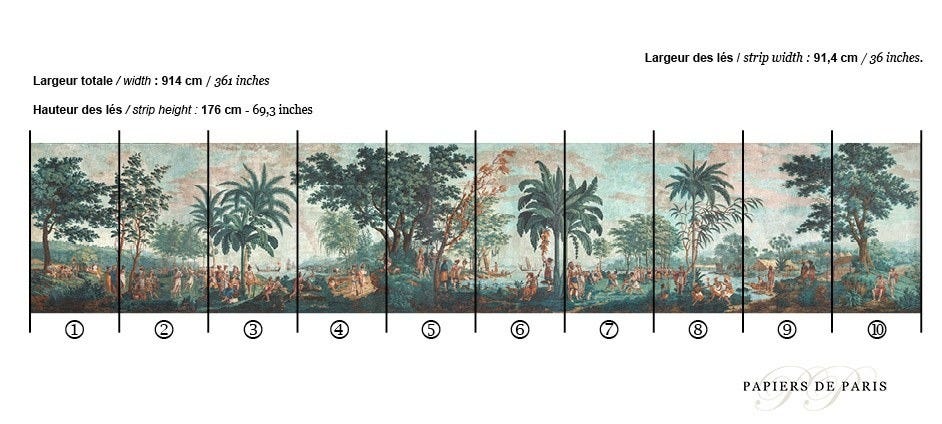
Where Bridge might have encountered Dorrance brings us to that amazing panoramic wallpaper of the “savages” about to meet Captain Cook, which hung in Reuel Williams’s octagonal parlor in the grandest mansion of Augusta, which “rivalled any wealthy merchant’s house in Boston or Salem” (Cohen 182). This unusual feature, which now hangs in a museum house in Deerfield, Massachusetts, brings Cohen to the verge to thematically linking sexual exploitation with “the triumph of the dominating and colonizing West” (183):
The men who saw the wallpaper—senators, presidents, important lawyers—could no doubt conclude that the adventure of exploration around the world was very attractive and exciting. They could think thoughts of Western mastery and conquest and of sensuous indulgence at the same time” (Cohen 183)
Perhaps that’s why male readers responded so wildly to Melville’s Typee. Of course, Melville also claimed to live with cannibals, and things didn’t end so well for Cook. Nevertheless, that octagonal wall-paper shows the extent of a systematic desire. Whether or not Bridge or any other man ‘seduced’ Dorcas, or, if, like Hester Prynne, she chose to act out her own destiny, she did not get from Augusta to Portland to Boston to 41 Turner Street in Manhattan on her own. Cohen’s deployment of “mystery novel” and “true crime” discourse does not raise these questions. Addressing contemporary journalists failures to investigate the alleged (and all-but convicted) murderer Richard P. Robinson, Cohen concedes, that like all of the men who might have seduced Dorcas, Robinson “had a vigilant family and lawyer working to defend his reputation—and plant stories and suspicion about Jewett and other suspects” (Cohen 231). Amazingly, Helen Jewett had defenders—and the evidence of her own writing to assert something of her own attempts at self-fashioning.
Which brings us back, sketchily, to Callahan’s Ask Now, and the larger matter of the discourses that legitimized and sustained Kennedy men, among so many others. Jackie Bouvier Kennedy Onassis’s self-fashioning compares to, and extends beyond almost anything Helen Jewett could have imagined into national myth-making—even if she suffered more at the hands of Kennedys and others. Callahan details that Jackie made up the Camelot reference, and, later, as an editor, greenlit Joseph Campbell’s books. I’m sure it’s just me that sees that as a tragic coping strategy with almost incomprehensible consequences for the perpetuation of exploitive misogyny under the cover of Arthurian hero’s journey bs.
Of course, Hugh Hefner coopted the sexual revolution to sell a retail version of the Kennedyesque exploitation of girls and young women that was the real “Camelot.” Granting that many women chose not to, why did women accede to this exploitation sold as innovation and revolution? Was their only choice between Professor Flostre or Dick Avery?
It’s not an academic question for me. Dressed as a Playboy Bunny, my mother pleas desperately from a 50's photo, while Barbara Santee looks on at some Tulsa cocktail party for oilmen and the like. My mother’s obvious horror, and Santee’s resigned, “well, what did you expect?” look symbolize, for me, the epiphanic moment when my mother realized that exploitation loomed either way, “country-club society marriage” or Hefner-Kennedy-Weinstein “revolution.” So many times: from 1840s Associationism through 20th century social experiments we have almost moved past this, and every time, “society” falls for the tranquilizers and the new old lies about how things have to be some way that they have never ever really been. Because, just as no one ever really writes about peeing and pooping in great literature, well, they leave the reason why that guy in Romance of the Forest wants Adeline. And, all-too-often, they’ve been normalized by co-opted, misread, or disingenuous forms of art.
Cohen, Patricia Cline, The Murder of Helen Jewett, Vintage, 1998.
Gilfoyle, Timothy J. City of Eros: Prostitution and the Commercialization of Sex, 1790-1920. Norton, 1992.
Hill, Marilyn Wood. Their Sister’s Keepers: Prostitution in New York City, 1830-1870. U Cal P, 1993.
Marchesani, Allie. Queering the Nineteenth Century Brothel: Identity and Sensory Experience at 12 Orange Street in the Five Points.
Smiley, Jane, A Dangerous Business (2022).
pales besides what @kaitjustice and the rest of the folks rebuilding the epstein files. BUT there is this whole archaeology of exploitation just laying there waiting to be attended to . . .
I worked in the field of infertility for a couple of decades. I worked in the labs. Every once in a while, a man would bring in his male relative or friend to provide the semen specimen to inseminate his wife - and he would say - don’t tell my wife. The reason was usually because the man had a vasectomy years ago and did not want his wife to know. It was common for men to have vasectomies so they could have affairs. These guys felt completely fine about deceiving their wives into having a child from someone else. I often wondered if, in these cases, the man was planning on staying with his wife, or divorcing her and denying child care $ since the baby could not be tied to him through paternity testing. Every time this happened, we notified the doctor.
I had a friend who was a nurse who was in the national guard and was sent to the Persian gulf. She said the most common procedure they performed was vasectomies. These guys were away from their wives and could do it without them knowing.